
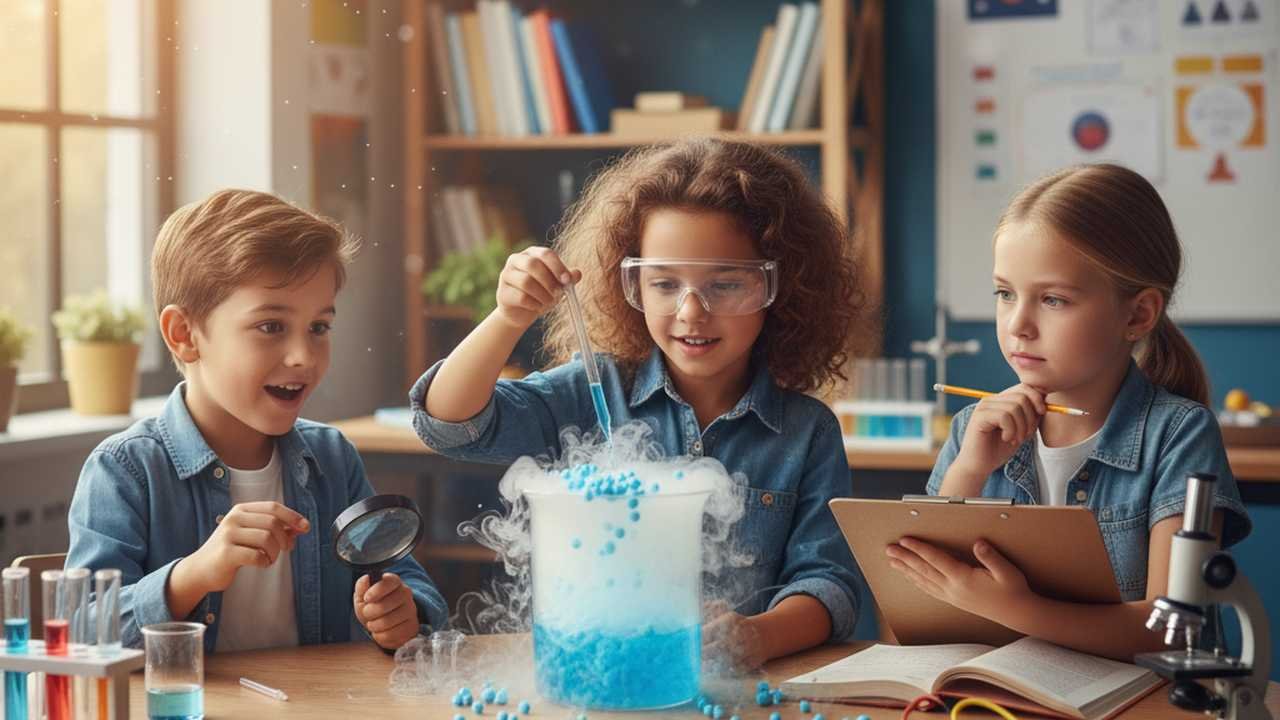
Imagine the crackle of static electricity jumping from your fingertips, the vivid eruption of a homemade volcano, or the mesmerizing dance of colors swirling in a jar of oil and water. These aren’t just experiments; they’re gateways to a world where curiosity reigns supreme. In today’s fast-paced, information-overloaded society, it’s easy to overlook the profound impact that hands-on science experiments have on fostering a deep, intrinsic curiosity in learners. Yet, these tactile experiences are more than mere activities – they are the bedrock of an idealist education that prioritizes inquiry, exploration, and the joy of discovery.
The Sensory Power of Hands-On Learning
There’s something uniquely captivating about engaging directly with materials. The coolness of a metal rod, the fizz of baking soda meeting vinegar, the vibrant hues of a chemical reaction – these sensory experiences create lasting impressions. When students participate in hands-on experiments, they don’t just observe science; they feel it, smell it, and see it unfold before their eyes. This multisensory engagement transforms abstract concepts into concrete understanding, making learning both memorable and meaningful. Such immersive experiences are at the heart of an idealist education, where the emphasis is on deep, experiential learning rather than rote memorization.
Curiosity: The Spark for Scientific Inquiry
At the core of every scientific endeavor lies a question: “What happens if…?” This innate curiosity drives the scientific process, prompting individuals to seek answers, test hypotheses, and explore the unknown. Hands-on experiments serve as the perfect catalyst for this inquisitive mindset. By allowing students to pose their own questions and design experiments to answer them, educators cultivate a sense of ownership and agency in the learning process. This approach not only enhances engagement but also nurtures critical thinking and problem-solving skills – essential components of an idealist education that values inquiry over instruction.
Bridging Theory and Practice
In traditional educational settings, students often grapple with the disconnect between theoretical knowledge and real-world application. Hands-on experiments bridge this gap by providing tangible experiences that bring abstract concepts to life. Whether it’s observing the principles of physics through simple machines or exploring chemical reactions in a lab, these activities allow students to see the practical implications of what they’ve learned. This experiential learning reinforces theoretical knowledge and demonstrates its relevance, making education more applicable and engaging. Such practical applications are central to an idealist education, where learning is rooted in real-world experiences.
Inquiry-Based Learning: A Student-Centered Approach
Inquiry-based learning shifts the focus from teacher-directed instruction to student-driven exploration. In this model, students are encouraged to ask questions, investigate phenomena, and draw conclusions based on evidence. Hands-on experiments are integral to this approach, providing students with the tools and opportunities to engage in authentic scientific inquiry. By fostering a classroom environment that values curiosity and critical thinking, educators can cultivate a generation of learners who are not only knowledgeable but also inquisitive and resourceful. This student-centered approach embodies the principles of an idealist education, emphasizing the development of independent thinkers.
Fostering Collaboration and Communication
Science is rarely a solitary endeavor. Collaborative efforts often lead to groundbreaking discoveries and innovations. Hands-on experiments provide students with opportunities to work together, share ideas, and communicate findings. This collaborative learning environment mirrors real-world scientific practice, where teamwork and effective communication are paramount. By engaging in group experiments, students develop interpersonal skills, learn to value diverse perspectives, and understand the importance of collective problem-solving. These experiences underscore the importance of collaboration in an idealist education, preparing students for success in both academic and professional settings.
Building Confidence Through Discovery
There’s a profound sense of accomplishment that comes from conducting an experiment and witnessing the results firsthand. Whether the outcome aligns with expectations or not, the process of discovery builds confidence and resilience. Students learn that failure is not a setback but a stepping stone toward understanding. This mindset encourages perseverance and a willingness to tackle challenges head-on. By embracing the trial-and-error nature of scientific inquiry, students develop a growth mindset that serves them well beyond the classroom. Such personal growth is a cornerstone of an idealist education, which aims to nurture well-rounded individuals.
Real-World Applications and Future Implications
The skills and knowledge gained through hands-on experiments extend far beyond the science lab. The critical thinking, problem-solving, and analytical skills developed are applicable in various fields, from engineering to environmental science. Moreover, the curiosity and inquiry fostered through these activities inspire lifelong learning and adaptability – traits essential in an ever-evolving world. By integrating hands-on experiments into the curriculum, educators equip students with the tools to navigate complex challenges and contribute meaningfully to society. This forward-thinking approach aligns with the goals of an idealist education, which prepares students for future success.
Integrating Technology to Enhance Experiential Learning
Advancements in technology have opened new avenues for enhancing hands-on learning experiences. Tools like augmented reality (AR) and virtual simulations allow students to explore scientific concepts in immersive and interactive ways. For instance, AR can superimpose visualizations of molecular structures or astronomical phenomena onto physical environments, providing a richer understanding of complex topics. By integrating such technologies into hands-on experiments, educators can cater to diverse learning styles and interests, making science more accessible and engaging. This integration of technology exemplifies the dynamic nature of an idealist education, which embraces innovation to enrich learning.
Encouraging a Lifelong Passion for Science
Hands-on experiments ignite a passion for science that can last a lifetime. The excitement of discovery, the thrill of experimentation, and the satisfaction of problem-solving instill a deep appreciation for the scientific process. Students who engage in hands-on learning are more likely to pursue careers in science, technology, engineering, and mathematics (STEM) fields, contributing to advancements that shape our world. By fostering this passion early on, educators play a pivotal role in cultivating the next generation of scientists and innovators. This enduring enthusiasm for learning is a hallmark of an idealist education, which seeks to inspire and empower students.
In conclusion, hands-on experiments are not merely educational activities; they are transformative experiences that cultivate curiosity, foster scientific inquiry, and promote a deeper understanding of the world. By embracing these experiential learning opportunities, educators can provide students with the tools to explore, question, and discover, laying the foundation for a lifetime of learning and growth. This commitment to inquiry and exploration is at the heart of an idealist education, which values the process of learning as much as the content itself.
