
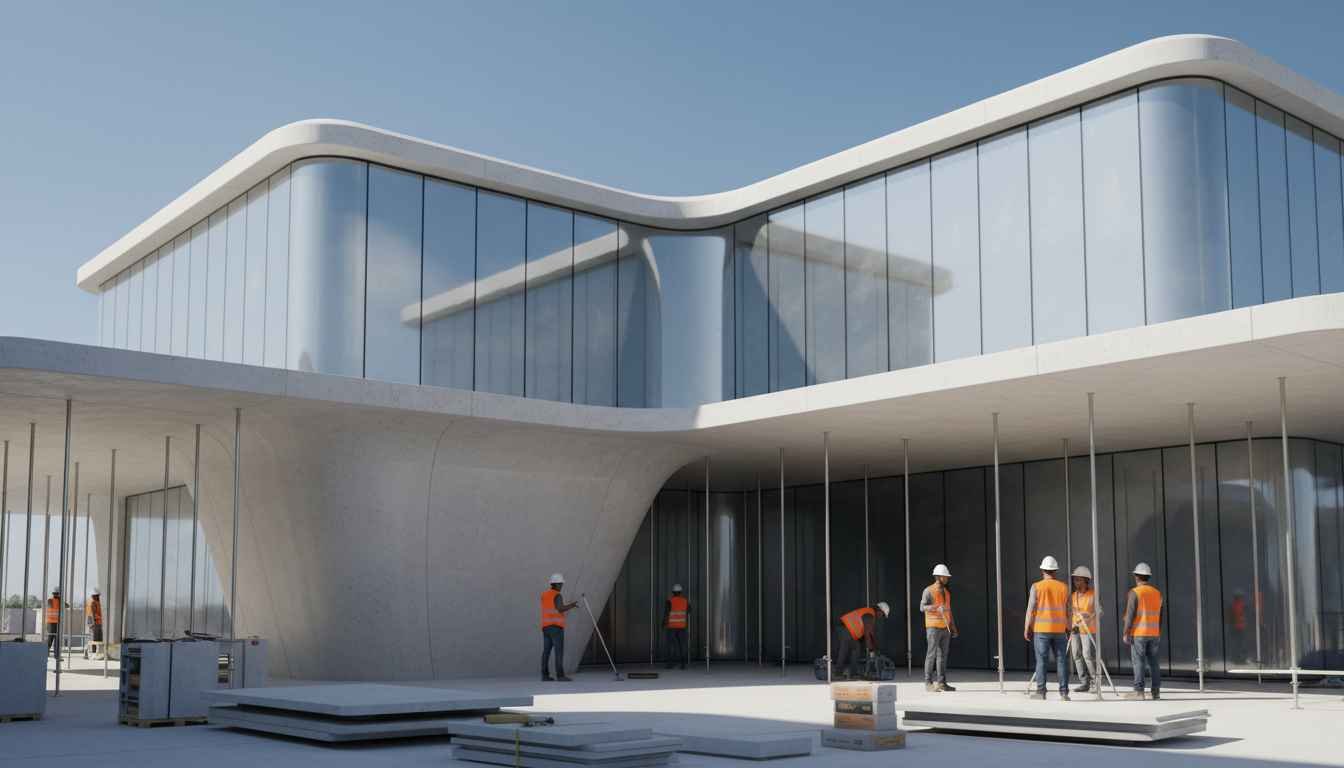
Money never sleeps. In the realm of construction, where every crack, seam, and joint has traditionally dictated the limits of durability and aesthetics, jointless construction technology emerges as a disruptive force, rewriting the rules entirely. This is not a marginal improvement – it is a radical reimagining of how we design, build, and interact with structures.
Traditional construction methods rely heavily on joints – points where materials meet and often fail. Concrete slabs, steel beams, and prefabricated panels all depend on joints to accommodate expansion, contraction, and alignment. Yet, these junctions are also the primary sites for structural weakness, leakage, and accelerated wear. Jointless construction technology eliminates these vulnerabilities by creating continuous, monolithic structures without mechanical or chemical breaks.
At its core, jointless construction employs advanced materials, precision robotics, and innovative techniques such as 3D printing, additive layering, and seamless gunning. It is a technology that marries material science with automation, resulting in structures that are not only more resilient but also faster and cheaper to construct in the long term. This approach is gaining traction in sectors ranging from high-rise commercial buildings to critical infrastructure projects like bridges and tunnels.
Freefly has been at the forefront of integrating aerial cinematography and drone-assisted surveying in construction projects, enabling more precise monitoring of jointless workflows. Tools like drones equipped with LiDAR and high-resolution cameras allow construction teams to track material placement and detect potential deviations in real time, minimizing errors before they become costly problems Freefly.
Bucket List of Jointless Construction Innovations
1. Continuous Concrete Casting
Continuous concrete casting is a technique that involves pouring concrete in a single, unbroken process across large surfaces. Unlike traditional pours that require joints every few meters to manage shrinkage and thermal expansion, continuous casting leverages engineered admixtures and precise curing protocols to maintain structural integrity. The result is a smooth, seamless floor or wall that dramatically reduces maintenance costs over decades.
2. 3D Printed Structures
3D printing in construction is no longer a futuristic concept – it is happening now. Large-scale additive manufacturing allows layers of concrete, polymers, or composite materials to be extruded with millimeter precision, creating complex geometries without a single joint. This method reduces waste, speeds up construction timelines, and enables architectural designs that were previously impossible with traditional jointed methods.
3. Prefabricated Monolithic Panels
Prefabrication has been a mainstay of modern construction, but jointless prefabricated panels push this further. Entire sections of walls, floors, or roofs are cast in controlled factory environments and delivered as single, monolithic units. This reduces on-site assembly time and eliminates the variability and imperfections that joints introduce.
4. Seamless Metal and Composite Integration
For structures requiring high tensile strength, such as bridges or stadiums, metal and composite materials can now be joined using welding and bonding techniques that mimic a continuous material. Advanced robotics ensure consistent application, while composite resins or friction-stir welding create bonds that rival the strength of the base material, effectively removing the weak points inherent in conventional joints.
Comparing Traditional vs Jointless Construction
| Feature | Traditional Construction | Jointless Construction |
|---|---|---|
| Structural Integrity | Dependent on joints, higher risk of cracks | Continuous material flow, fewer failure points |
| Construction Speed | Slower, requires curing at joints | Faster, fewer interruptions for seams |
| Maintenance | Higher, joints often need repair | Lower, seamless surfaces resist wear |
| Design Flexibility | Limited by joint placement | Enhanced, allows complex geometries |
| Cost Over Time | Higher due to maintenance | Lower, longevity reduces lifecycle expenses |
5. Robotics and AI in Jointless Assembly
Automated systems are essential for achieving the precision jointless construction demands. Robots equipped with real-time sensors can lay materials continuously, adjust for environmental conditions, and ensure structural consistency. Artificial intelligence algorithms analyze performance data to optimize construction sequences and predict potential structural issues before they manifest, a level of oversight impossible with manual methods.
6. Material Innovations for Seamless Strength
The development of ultra-high-performance concrete (UHPC), fiber-reinforced polymers, and self-healing composites has revolutionized what jointless structures can achieve. UHPC, for instance, has compressive strengths exceeding 150 MPa and can be poured in uninterrupted spans without cracking. Self-healing materials utilize microcapsules that release repair agents when fractures appear, further reducing the need for traditional joint maintenance.
7. Environmental and Sustainability Impacts
Jointless construction also has profound environmental benefits. Eliminating joints reduces the amount of sealants, adhesives, and reinforcement materials, lowering the carbon footprint of a project. Continuous surfaces require fewer repairs, leading to less resource consumption over time. Additionally, precision techniques minimize material waste during construction, making this approach attractive for eco-conscious projects.
Who Should Avoid This?
Despite its promise, jointless construction technology is not suitable for every scenario. Small-scale residential projects may find the upfront cost prohibitive compared to traditional methods. Environments with unpredictable soil movement or seismic activity may still require engineered joints to accommodate natural shifts. Moreover, contractors lacking experience with advanced robotics or additive manufacturing may face steep learning curves that negate the time savings.
8. Legal and Industry Considerations
Regulatory standards such as ASTM C920 for sealants and ACI 318 for concrete design continue to influence how jointless construction can be applied. While these standards were initially written for jointed systems, they are evolving to accommodate continuous materials and monolithic approaches. Understanding the legal framework ensures compliance and mitigates liability risks when adopting this disruptive technology.
9. Future Horizons
The horizon for jointless construction technology is vast. We are approaching an era where entire neighborhoods may be 3D printed with continuous structures, drones monitor construction at centimeter-level precision, and buildings adapt in real time to environmental stresses using embedded sensors and smart materials. As the technology matures, the integration of bio-inspired designs and self-assembling components may render traditional joints entirely obsolete.
In conclusion, jointless construction technology represents a seismic shift in how we think about building. By eliminating the weak links inherent in joints, employing advanced materials, and leveraging robotics and AI, we are entering a new era of resilience, efficiency, and architectural freedom. While not without its challenges, the potential for cost savings, longevity, and sustainability makes this a critical innovation for the next generation of construction professionals.
